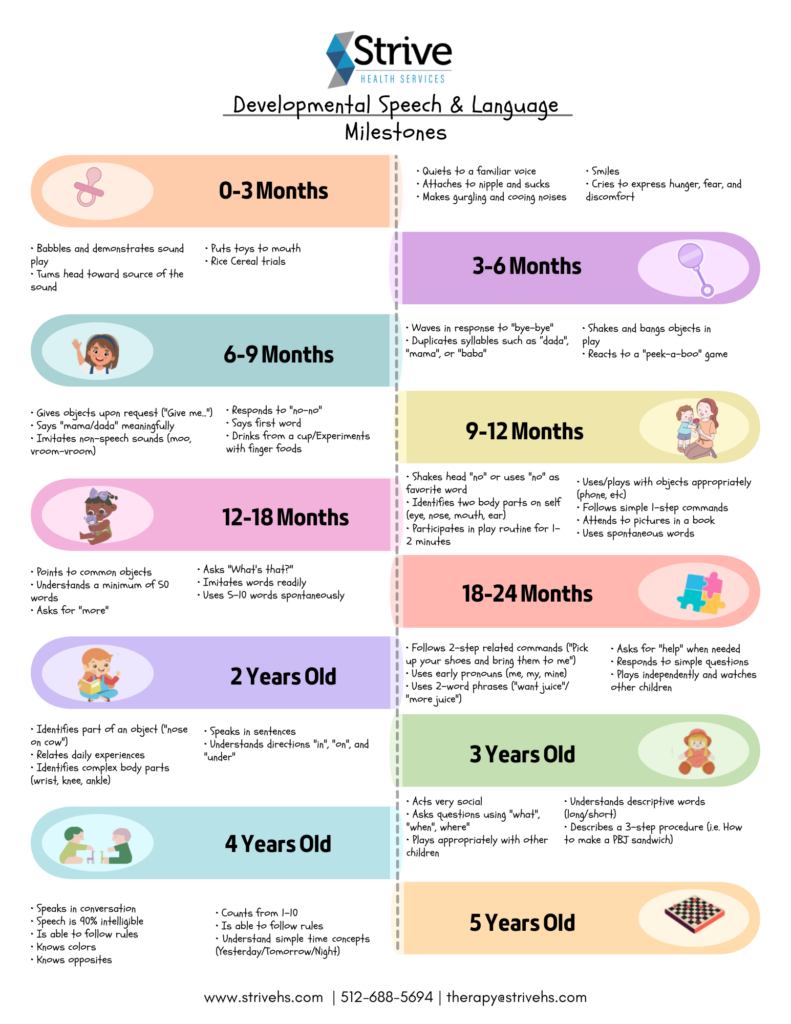
What should my baby be doing at 0–3 months? During the first few months of life, babies are already developing important communication skills. While every child develops at their own pace, understanding early speech and language milestones can help parents and caregivers recognize how their baby is beginning to communicate and interact with the world around them.
As part of Strive Health Services’ Developmental Speech & Language Milestones Series, our speech therapy team is breaking down important milestones by age range to help families better understand early communication development.
In this first video, Dulce, a Speech-Language Pathologist Intern at Strive, discusses some of the speech, language, feeding, and communication milestones families may observe from birth to 3 months.
Watch the Video: See Dulce, Speech-Language Pathologist Intern at Strive, break down 0–3 month developmental milestones.
Speech & Language Milestones for 0–3 Months
During the first three months, babies communicate primarily through sounds, facial expressions, body movements, and crying. Some early milestones to look for include:
Quiets to a familiar voice
Your baby may begin to recognize familiar voices and respond by becoming quiet, changing their movements, or paying attention when they hear someone they know.
Talking, singing, and reading to your baby can provide opportunities for them to hear and become familiar with the sounds of language.
Attaches to the nipple and sucks
Feeding is an important part of early development. Babies are developing the coordination needed to suck, swallow, and breathe during feeding.
Feeding skills are closely connected to oral-motor development and can play an important role in a baby’s overall development.
Makes gurgling and cooing noises
Around this age, babies may begin experimenting with their voices by making gurgling, cooing, and other sounds.
These early vocalizations are an important part of learning how communication works. When your baby makes a sound, try responding back. This creates an early back-and-forth interaction that supports communication development.
Smiles
Babies may begin smiling in response to interaction with familiar people. Smiling and other facial expressions are early ways babies begin to engage socially and communicate with caregivers.
Try smiling, talking, and making facial expressions back to your baby to encourage these early interactions.
Cries to express hunger, fear, and discomfort
Crying is one of the primary ways newborns communicate their needs. A baby’s cry may communicate hunger, discomfort, fear, tiredness, or a need for attention.
Over time, parents and caregivers often become familiar with their baby’s different cries and other cues.
When Should I Be Concerned About My Baby’s Development?
Development doesn’t look exactly the same for every child. Milestones are helpful guidelines, but they are not meant to diagnose a developmental delay on their own.
If you have concerns about your child’s communication, feeding, or overall development, talk with your child’s pediatrician or a qualified pediatric therapist. Early conversations can help families understand their child’s individual needs and determine whether additional support may be helpful.
Supporting Your Child’s Development at Strive
At Strive Health Services, our pediatric therapy professionals work alongside children and families to support development and help children reach their individual goals.
Our speech-language pathologists can support children with a variety of communication and feeding needs. If you have concerns about your child’s speech, language, communication, or feeding development, our team can help you understand what support may be appropriate.
LEARN MORE ABOUT STRIVE’S SPEECH THERAPY SERVICES
Continue the Series:
Next: [Speech & Language Milestones: 3–6 Months]